Quick answer
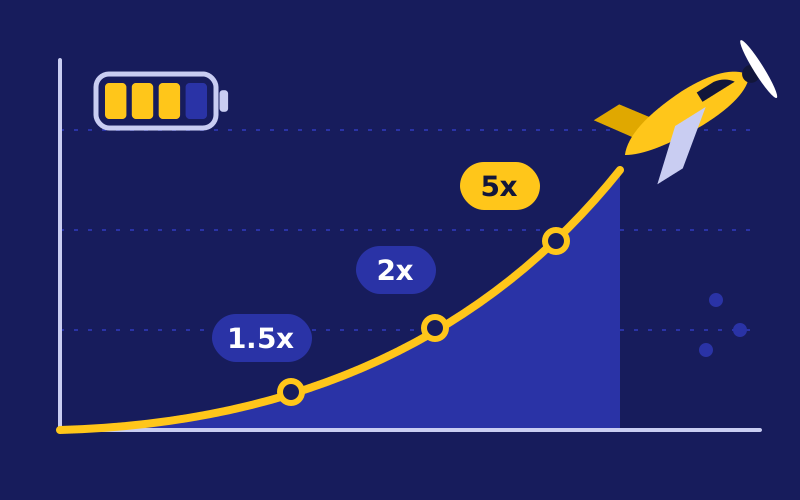
- Aviator is a crash game made by Spribe and launched in 2019. Battery Bet (Batery) carries it in its casino section, and the rules are the same there as on any other site that hosts the game.
- The published return to player is 97%. The chance of the multiplier reaching any target x is roughly 0.97 divided by x, so a 2x cash-out lands about 48.5% of the time and a 10x cash-out about 9.7% of the time.
- Expected value is about minus 3% of everything you stake, whether you aim for 1.2x or 100x. Your choice of target changes how bumpy the ride is, not what it costs on average.
- The game is provably fair: each round's result comes from a server seed and three players' client seeds run through SHA-512, and you can check any finished round yourself.
- Predictor apps, signal channels and "hacks" cannot see the next round. They are scams, and many carry malware.
- Batery holds a Curaçao gaming licence, number OGL/2024/107/0914, issued to its operator YouGMedia B.V. The game still carries a house edge, so treat any stake as money you may lose.
- Game maker
- Spribe
- Launched
- 2019
- Published RTP
- 97%
- Starting multiplier
- 1.00x
- Bets per round
- Up to two
- Fairness check
- Provably fair, SHA-512
What is Aviator on Battery Bet, and who makes it?
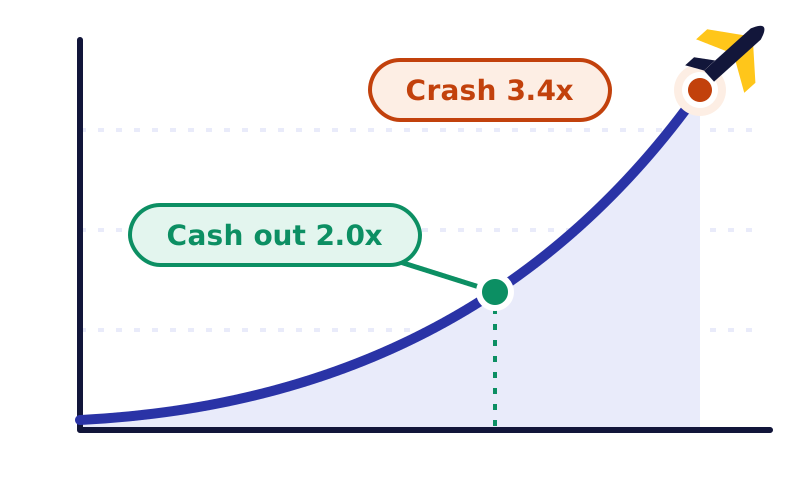
Aviator is a crash game. There are no reels, cards or paylines. A small plane takes off, a multiplier next to it rises from 1.00x, and at a moment nobody can see in advance the plane flies away. If you pressed cash out before that moment, your stake is multiplied by whatever the counter showed. If you did not, the stake is gone.
The game is built by Spribe, a studio that released it in 2019. That detail matters more than it sounds. Battery Bet (Batery) does not write the game, run its random number generation or set its return. The operator rents the title from the studio and embeds it in its lobby, in the same way it embeds thousands of slots from other suppliers. So when people search for "battery bet aviator" or "aviator battery bet", what they find is the standard Spribe game inside a Batery account, with Batery's wallet, limits and bonus terms wrapped around it.
This split matters. Questions about the game itself (odds, fairness, how a result is produced) have the same answer everywhere Aviator is hosted. Questions about money (deposits, withdrawals, bonus terms) depend entirely on the operator.
Legal position in India. The Promotion and Regulation of Online Gaming Act, 2025 received presidential assent on 22 August 2025, and the Online Gaming Rules were notified on 22 April 2026. The Act prohibits offering online money games, advertising them and facilitating payments for them, with penalties aimed at operators, advertisers and payment facilitators rather than individual players. Aviator played for real stakes on an offshore site falls squarely inside the kind of product the Act targets. Batery holds a Curaçao gaming licence (number OGL/2024/107/0914, operator YouGMedia B.V.). The licence is issued in Curaçao, and Indian law on real-money gaming applies separately. In practice no Indian ombudsman hears disputes with the operator, and sites or payments can be blocked. Challenges to the Act were consolidated in the Supreme Court, so check the current status. This is general information, not legal advice.
How does a round of Battery Bet Aviator work?
Every round follows the same short cycle. Understanding it precisely is useful, because most myths about the game come from misreading one of these stages.
The betting window opens
Between rounds there is a short pause of a few seconds. During it you enter a stake in one or both bet panels and confirm. If you miss the window, your bet is queued for the following round rather than the one about to start.
The result is already fixed
Before the plane moves, the crash point for the round has been determined from cryptographic seeds. Nothing you or anyone else does during the flight alters it. The animation is a replay of a number that already exists.
The multiplier climbs from 1.00x
The counter rises slowly at first and then faster. Your potential payout at any instant is your stake times the number on screen.
You cash out, or you do not
Pressing cash out locks the multiplier shown at that moment. If you set auto cash-out, the game does this for you at your chosen number. On a slow connection your manual tap can reach the server later than you see it, which is one reason auto cash-out is the more reliable tool.
The plane flies away
At the crash point the round ends. Every bet still open loses its full stake. Bets already cashed out are paid to the balance.
The round is published
The final multiplier joins the history strip, and the seeds used to generate it become available for checking. Then the next betting window opens.
A walk through the Aviator screen
The layout is the same in a phone browser, in the Batery app and on desktop, although panels stack vertically on small screens. These are the parts you will use.
Flight area
The central canvas with the plane, the curve and the live multiplier. It carries no information beyond the current number. The shape of the curve does not hint at when it will end.
Two bet panels
You can place two independent bets in the same round, each with its own stake and its own cash-out. People use this to cash one bet early and let the other run. It doubles your stake per round, which is easy to overlook.
Auto bet
Repeats your stake every round without a tap. Depending on the version you see, it may offer stop conditions such as a balance floor. Without a stop condition, auto bet will keep staking until the balance is empty.
Auto cash-out
Cashes the bet at a multiplier you set in advance. It removes hesitation and connection lag from the decision. It is the only feature on the screen that makes your play more disciplined rather than faster.
Live bets feed
A scrolling list of other players' stakes and cash-outs in the current round, usually with tabs for your own bets and top results. It is entertainment. Other players have no more information than you do.
History strip
A row of recent crash multipliers, often colour-coded by size. Tapping an entry normally opens that round's fairness details. The strip describes the past only, as the odds section below explains.
Stake limits and any maximum multiplier or maximum win are set per operator, so read them in the game's own limits panel inside your Batery account. A capped top end slightly lowers the true return of long-shot targets.
What are the real odds in Aviator?
The published return to player (RTP) for Aviator is 97%. RTP is a long-run average: across a very large number of rounds, about ₹97 of every ₹100 staked is paid back to players and about ₹3 is kept. It is not a promise about your session, your day or your month.
What makes Aviator unusually easy to analyse is that this one number fixes the entire probability structure. For the game to return 97% at every possible cash-out point, the chance of the multiplier reaching a target x has to be approximately 0.97 divided by x.
Where the formula comes from
Take a target of 2x. If you win, a ₹100 stake returns ₹200. For the average return to be ₹97, you must win with probability p where p × 200 = 97, so p = 0.485. Repeat the same sum for any other target and you get p = 0.97 / x. The game is designed so that this holds across the board, which is why no cash-out point is "better value" than another.
The same formula tells you where the house edge physically sits. Put x = 1.00 into it and the probability of the multiplier getting past the starting line is about 97%. In other words, under this model roughly three rounds in every hundred end at or immediately after 1.00x, before any cash-out is possible. Those instant crashes are the 3%. Everything else about the game is a fair bet in the mathematical sense.
| Cash-out target | Chance the round reaches it | Roughly one round in | Break-even chance with no house edge | Profit on a ₹100 stake if it lands | Average result per ₹100 staked |
|---|---|---|---|---|---|
| 1.2x | 80.83% | 1.24 | 83.33% | ₹20 | −₹3 |
| 1.5x | 64.67% | 1.55 | 66.67% | ₹50 | −₹3 |
| 2x | 48.50% | 2.06 | 50.00% | ₹100 | −₹3 |
| 3x | 32.33% | 3.09 | 33.33% | ₹200 | −₹3 |
| 5x | 19.40% | 5.15 | 20.00% | ₹400 | −₹3 |
| 10x | 9.70% | 10.31 | 10.00% | ₹900 | −₹3 |
| 50x | 1.94% | 51.55 | 2.00% | ₹4,900 | −₹3 |
| 100x | 0.97% | 103.09 | 1.00% | ₹9,900 | −₹3 |
Read the fourth column against the second. At every target, the real chance is slightly below the chance you would need to break even. The gap looks tiny at 100x (0.97% against 1%) and larger at 1.2x (80.83% against 83.33%), but in proportion it is the same 3% shortfall each time.
Expected value is minus 3% at every target
Here is the 2x case worked in full. Stake ₹100 with auto cash-out at 2x. With probability 0.485 you gain ₹100. With probability 0.515 you lose ₹100. The average is (0.485 × 100) − (0.515 × 100) = −₹3.
Now the 10x case. With probability 0.097 you gain ₹900. With probability 0.903 you lose ₹100. The average is 87.30 − 90.30 = −₹3. The same sum at 1.2x gives 16.17 − 19.17 = −₹3. You can check any row in the table this way and the answer does not move.
The cost of playing is therefore driven by one thing: total turnover. Suppose you stake ₹100 a round and play 150 rounds in an evening. You have put ₹15,000 through the game, and the expected cost is 3% of that, about ₹450, even though you may never have had more than a few thousand rupees in the account. Fast rounds turn a small edge into a meaningful hourly cost.
Note. Manual cash-out does not escape this arithmetic. Cashing out by hand at varying points is simply a mixture of different targets, and a mixture of bets that each lose 3% on average also loses 3% on average. The crash point is fixed before the round, so your timing cannot interact with it.
Does the history strip tell you what comes next?
No. Each round's result is generated from fresh seeds and has no memory of the previous rounds. After ten low crashes in a row, the chance that the next round reaches 2x is still about 48.5%. After a 200x round, it is still about 48.5%.
The belief that a big multiplier is "due" after a cold run is the gambler's fallacy, and the belief that the game is "hot" is the same error in reverse.
If you have read the odds above and still want to see the game inside a Batery account, the button below is our commercial link to the operator.
18+ only. Terms apply. Real-money play carries financial risk and may be restricted where you live.How swingy is Aviator? Variance and losing streaks
If every target costs the same on average, what does your choice of target actually change? The answer is variance: how far and how fast your balance moves away from that average, in both directions. This is the part of the game most players underestimate, and it is the part that empties accounts.
A useful measure is the standard deviation of a single ₹100 bet, which is the typical size of the swing around the average result. At a 1.2x target it is about ₹47. At 2x it is about ₹100. At 10x it is about ₹296, and at 100x it is about ₹980. The expected loss is ₹3 in all four cases. Chasing high multipliers buys you roughly twenty times the turbulence of low ones for exactly the same price.
How likely is a long losing streak?
Rounds are independent, so the chance of losing n rounds in a row at a fixed target is the single-round loss probability raised to the power n. At a 2x target the loss probability is 1 − 0.485 = 0.515, so ten straight losses has probability 0.51510, which is about 0.13%, or roughly one in 760.
| Target | Chance of losing one round | 5 losses in a row | 10 losses in a row | 20 losses in a row |
|---|---|---|---|---|
| 1.2x | 19.17% | 0.03% | Under 0.001% | Negligible |
| 1.5x | 35.33% | 0.55% | 0.003% | Negligible |
| 2x | 51.50% | 3.62% | 0.13% | Under 0.001% |
| 3x | 67.67% | 14.19% | 2.01% | 0.04% |
| 5x | 80.60% | 34.02% | 11.57% | 1.34% |
| 10x | 90.30% | 60.04% | 36.05% | 12.99% |
| 50x | 98.06% | 90.67% | 82.21% | 67.58% |
| 100x | 99.03% | 95.24% | 90.71% | 82.29% |
At a 10x target, twenty rounds without a hit happens about 13% of the time from any starting point. At 100x, expect it more than four times out of five.
Why rare streaks stop being rare over a long session
The table gives the chance of a streak starting at one particular round. A session contains many starting points, so the chance of meeting a streak somewhere inside it is far higher. This is the figure that matters for anyone using a staking system that breaks after a set number of losses.
| Rounds played | At least one run of 6 losses | At least one run of 8 losses | At least one run of 10 losses |
|---|---|---|---|
| 100 | 60.3% | 20.6% | 5.7% |
| 200 | 84.8% | 37.8% | 11.6% |
| 500 | 99.2% | 70.2% | 27.0% |
| 1,000 | Almost certain | 91.2% | 47.0% |
Play a thousand rounds, which a regular player can do in a week, and you have close to an even chance of meeting a ten-loss streak. A six-loss streak is more likely than not inside your first hundred rounds.
Can you be ahead after a long session?
Yes, in the short run, and that is what keeps people playing. Take 1,000 rounds of ₹100 at 2x. The expected result is a loss of ₹3,000, and the typical swing around that figure is about ₹3,160. That leaves roughly a one-in-six chance of finishing in profit.
Stretch it to 10,000 rounds and the picture hardens. The expected loss is ₹30,000 and the typical swing is about ₹10,000, so finishing ahead becomes roughly a one-in-750 outcome. The edge grows in proportion to the number of rounds, while luck grows only with its square root. Over enough play, the edge always overtakes the luck.
Try it with the simulator
The tool below runs imaginary rounds using the same 0.97 / x model as the tables above. No money, account or real game data is involved.
How to read the output: run the same settings several times and watch the net result move. At 1,000 rounds with a 2x target, some runs finish in profit and most do not, scattered around a loss of 3% of total stakes. At 10,000 rounds the scatter tightens around that loss. Then raise the target to 10x or 50x and look at the longest losing run, which is the streak your bankroll would have had to survive. The simulator cannot forecast a real session. It shows that outcomes are wide in the short run and converge on a loss as rounds accumulate.
How does provably fair work in Aviator, and how do you verify a round?
"Provably fair" is a specific technical claim, not a marketing adjective. It means the round result is produced by a public recipe from ingredients that are committed to before bets are placed and revealed afterwards, so that anyone can redo the calculation and confirm the result was not changed mid-round.
The mechanism, step by step
The server prepares a secret seed
Before the round, the game server generates a random value called the server seed. It keeps the seed secret but can publish a hash of it. A hash is a one-way fingerprint: easy to compute from the seed, practically impossible to reverse.
Players contribute their own seeds
The first three players to bet in the round each contribute a client seed generated on their side. The operator and the studio do not choose these values, which is the point. The result now depends on inputs the house did not control.
The seeds are combined and hashed
The server seed and the three client seeds are joined together and passed through SHA-512, a standard cryptographic hash function. The output is a long hexadecimal string that looks random and changes completely if any single input character changes.
The hash is converted into a multiplier
A fixed, published formula turns that string into the crash point. The same string always gives the same multiplier, and the formula is where the 97% return is built in.
Everything is revealed after the round
Once the plane has flown away, the server seed, the three client seeds, the combined hash and the resulting multiplier are shown in the round's details.
How to check a finished round yourself
Menu labels vary slightly between versions of the game, so treat this as the general route.
- Open the round history and tap the multiplier of the round you want to inspect, or open the provably fair item in the game menu.
- Note the server seed, the three client seeds and the combined SHA-512 hash shown for that round.
- Paste the seeds, joined in the order the game shows them, into any independent SHA-512 calculator. Use one that runs offline or in your browser, not one promoted by a tipster.
- Compare the output with the hash displayed in the game. A character-for-character match shows the published inputs do produce the published hash.
- If the game shows the hash of the server seed before the round, hash the revealed server seed too and confirm it matches. That confirms the seed was not swapped after betting closed.
What a successful check proves, and what it does not
A match proves that this round's result followed from seeds fixed before the outcome was known, including seeds supplied by players. It rules out the most common suspicion, that the game crashes early because it "saw" a large bet.
It does not prove three other things. It does not audit the long-run return, which depends on the conversion formula and is a matter for the studio's certification. It does not show that the operator will pay your withdrawal. And it does not show that you are on the genuine site: a clone can display a copied interface with fake seed panels. For that last check, see our evidence-based review of whether Battery Bet is real or fake, which covers the licence footer, operator name and clone-site signs.
Tip. Verifying two or three rounds once is worthwhile because it shows you how the system works. Verifying rounds repeatedly in the hope of spotting a pattern is not. SHA-512 output is designed so that past hashes give no information about future ones.
Why can't predictors, signals or hacks beat Battery Bet Aviator?
Search for the game and you will be offered predictor apps, Telegram signal channels, "AI bots" and hacked APKs that claim to show the next crash point. None of them can work, and the reason follows directly from the fairness mechanism above.
The four reasons prediction is impossible
- The key input is secret. The server seed stays on the game server until the round is over. An app on your phone has no channel to read it.
- The hash cannot be reversed. Even if a hash of the seed is published in advance, working backwards from a SHA-512 hash to its input is not feasible with any existing computing power.
- Other inputs do not exist yet. The client seeds come from the first three players to bet in that round. Until they bet, part of the recipe has not been created, so the result cannot be computed by anyone, including the house.
- Rounds are independent. Because each round uses fresh seeds, history contains no signal. An "AI" trained on past multipliers is fitting patterns to noise.
How the scams actually make money
Since the product cannot work, the business model has to lie elsewhere. Public reports describe a few recurring versions.
The first is paid access: a subscription or "activation fee". The second is referral steering: the predictor only "works" if you register through the seller's link, which earns the seller a commission on your losses. The third is malware: a sideloaded APK that requests SMS, accessibility or screen-overlay permissions can read one-time passwords and watch you type a UPI PIN. The fourth is account theft, where the "tool" asks for your casino login.
Signal channels rely on a statistical trick. A tip to "cash out at 1.5x" wins about 65% of the time by pure chance, so a channel can post an impressive record of screenshots while its followers lose 3% of turnover like everyone else.
Warning. Never install an Aviator predictor or modified game APK, and never give anyone your Batery password, an OTP or your UPI PIN. There is also no official Battery Bet phone or WhatsApp number, so a caller offering "Aviator tips" or a "winning account" in the brand's name is not from the operator. Our page on the Battery Bet helpline question lists the real support channels. If you have already lost money to such a scheme, call the national cybercrime helpline on 1930, report it at cybercrime.gov.in and contact your bank immediately.
Do Aviator strategies work? An honest look at the popular systems
A staking system decides how much you bet and where you cash out. It cannot touch the probability of each round, so it cannot change the 3% expected loss. What it can do is reshape the pattern of results: many small wins and a rare disaster, or many small losses and a rare windfall.
| System | How it works | What it changes | Expected loss | How it fails |
|---|---|---|---|---|
| Martingale | Double the stake after every loss at about 2x, reset after a win | Many small wins, occasional very large loss | 3% of total staked | A losing run outgrows the bankroll or the stake limit |
| Two-bet cover | A larger bet cashed at about 1.5x to cover a smaller bet left to run | Fewer losing rounds, but each one costs both stakes | 3% of total staked | Crashes below 1.5x, about 35% of rounds, lose everything staked |
| Low-multiplier grinding | Auto cash-out at 1.1x to 1.3x every round | High hit rate, small swings per round | 3% of total staked | One loss erases about five wins, and turnover climbs quickly |
| D'Alembert | Raise the stake one unit after a loss, lower it one unit after a win | Gentler stake growth than Martingale | 3% of total staked | Slow bleed, with stakes drifting upwards in cold spells |
A worked Martingale example in rupees
Suppose you bring ₹10,000, start at ₹100 with auto cash-out at 2x, and double after each loss. Any win recovers the earlier losses and leaves you ₹100 ahead.
| Bet in the run | Stake | Total lost if this bet also loses | Chance of losing this many in a row |
|---|---|---|---|
| 1 | ₹100 | ₹100 | 51.50% |
| 2 | ₹200 | ₹300 | 26.52% |
| 3 | ₹400 | ₹700 | 13.66% |
| 4 | ₹800 | ₹1,500 | 7.03% |
| 5 | ₹1,600 | ₹3,100 | 3.62% |
| 6 | ₹3,200 | ₹6,300 | 1.87% |
| 7 | ₹6,400 needed | Cannot be placed: only ₹3,700 is left | Not reached |
Six straight losses end the system with ₹6,300 gone. Each cycle therefore wins ₹100 about 98.13% of the time and loses ₹6,300 about 1.87% of the time. The average is (0.9813 × 100) − (0.0187 × 6,300), which comes to about −₹19.40 a cycle. The average amount staked per cycle is about ₹647, and 3% of ₹647 is ₹19.40. The edge has not moved.
The chance of completing 50 cycles in a row without ruin is about 39%, and of completing 100 it is about 15%. Most people who try this see a pleasant run of ₹100 wins and conclude it works, until the one cycle that takes back 63 of them. A bigger bankroll only postpones that cycle and makes it larger.
The two-bet idea, checked
Suppose you place ₹200 with auto cash-out at 1.5x and ₹100 with auto cash-out at 5x. Below 1.5x (35.33% of rounds) you lose ₹300. Between 1.5x and 5x (45.27%) the first bet's ₹100 profit covers the second bet's loss and you finish level. At 5x or above (19.40%) you gain ₹500. The average is 97.00 − 106.00 = −₹9, which is 3% of the ₹300 staked. The "cover" is real in most rounds, and the price is a ₹300 loss about one round in three.
What a sensible approach looks like
The only useful choices are those that limit turnover and variance: flat stakes, a modest auto cash-out target, a fixed number of rounds and a fixed loss limit. That is risk control, a way to lose more slowly on average, and not a winning method.
What bankroll and session rules make sense for Aviator?
Treat the money as the price of entertainment. The rules below exist to keep that price close to what you intended to pay.
The 1% guideline comes from the streak tables. With ₹2,000 and ₹20 stakes at 2x, even a ten-loss run costs ₹200, a tenth of the budget. With ₹200 stakes, the same run ends the session.
Use demo mode first
Aviator normally has a demo or "fun" mode that runs on play credits. Whether it opens before login depends on the lobby, so look for the option on the game tile. Use it to learn the bet panels, set auto cash-out and watch how often rounds end below 1.5x.
Demo play has one known side effect. Losing pretend money does not hurt, so people take risks in demo that they would not take with real funds, see a big multiplier land, and carry that confidence into real play. Decide your real stake and target before you leave the demo.
How do you find and play Aviator on Battery Bet?
We describe the general route from public descriptions of the site. Izaro News is an independent guide: we have no access to accounts and did not play the game ourselves.
Finding the game in the lobby
Crash titles as popular as Aviator are usually given a shortcut in the main menu or the top row of the casino page. If you do not see one, open the casino section and use the search box, or filter the provider list by Spribe. Confirm the provider name on the tile, since lobbies often carry look-alike crash games from other studios with different rules and returns. You need a registered, logged-in account to stake real money. Our Battery Bet login and sign-up guide covers that part.
Playing on mobile
The game runs inside a mobile browser and inside the Batery app. On Android the app is an APK from the operator's own site, and on iPhone it is a web app added from Safari. Our Battery Bet APK guide explains the install and the safety checks. For Aviator specifically, a stable connection matters more than the device: if the signal drops mid-flight, a manual cash-out may not register, while an auto cash-out set beforehand is handled on the server side. Avoid playing on a weak mobile signal or while moving between networks.
Does Aviator count towards bonus wagering?
Do not assume so. Casino bonuses apply game weighting: slots commonly count in full, while low-edge games count at a reduced rate or are excluded. Crash games are frequent candidates for a reduced rate or exclusion because their 3% edge clears wagering cheaply. Some terms also cap the maximum bet while a bonus is active or void winnings from very low multipliers.
Published descriptions of the Batery welcome offer differ between reviewers, and we have not seen a reliable public statement of the Aviator weighting. Read the terms of the offer inside your own account, and ask live chat to confirm in writing before you play Aviator with bonus funds. The maths behind this is set out in our Battery Bet bonus guide.
Money in, money out
The odds of the game are the same everywhere. What differs by operator is payment handling. Reviewers describe Batery deposits by UPI, PhonePe, Paytm, Google Pay, bank transfer, AstroPay and crypto as instant, and withdrawals with a stated processing time of up to 72 hours, usually back to the method and name used to deposit. Indian banks can decline or reverse UPI payments to offshore gaming merchants. See our pages on deposit problems and withdrawal time before you fund an account.
How does Aviator compare with other crash games and casino games?
Most lobbies list several crash-style titles from other studios. The mechanics come in a few families: a single rising multiplier as in Aviator, versions that let you cash out half your bet, and "mines" or "tower" formats where each safe pick raises the multiplier. Returns differ by title, and not all of them offer a provably fair check, so open each game's information panel and read the published RTP rather than assuming it matches Aviator's 97%.
Against the wider casino, a 3% edge is moderate. Single-zero roulette has an edge of 2.70% on every bet, which follows from its 37 pockets. Slots vary widely by title and are often less generous. The more important comparison is speed: a game that settles several rounds a minute generates far more turnover per hour than a roulette table, so the hourly cost of Aviator can be higher than its edge suggests.
How we rate Aviator on Battery Bet
These are editorial scores reasoned from public information, not test results. Transparency is high because the return is published and each round can be verified, with half a point held back because the check does not audit the long-run return. The return score reflects a 3% edge, better than many slots and no better than roulette. Volatility control is decent because auto cash-out lets you choose your variance, but nothing limits turnover. Protection against chasing is low: seconds-long rounds, two bet panels and auto bet all make it easy to stake more after a loss.
What works
- Published 97% return and simple, checkable odds
- Provably fair rounds that any player can verify
- Auto cash-out lets you fix your risk level in advance
- Demo mode for learning the screen without stakes
What to watch
- Every target loses 3% of turnover on average
- Very fast rounds make losses accumulate quickly
- Bonus terms may reduce or exclude Aviator stakes
- UPI payments to offshore gaming merchants can be declined or reversed by Indian banks
- Heavy scam activity around predictors and signals
Aviator costs about 3% of everything you stake and nothing can predict it. If you choose to play on Batery anyway, set a budget first and use the button below.
18+ only. Terms apply. Real-money play carries financial risk and may be restricted where you live.What are the signs you should stop playing Aviator?
Crash games are built around the near miss. Cashing out at 1.9x and watching the plane climb to 40x feels like a loss even though you won, and losing at 1.95x on a 2x target feels like bad timing rather than chance. Both feelings push towards higher targets and bigger stakes, which is why stopping rules matter more here than in slower games.
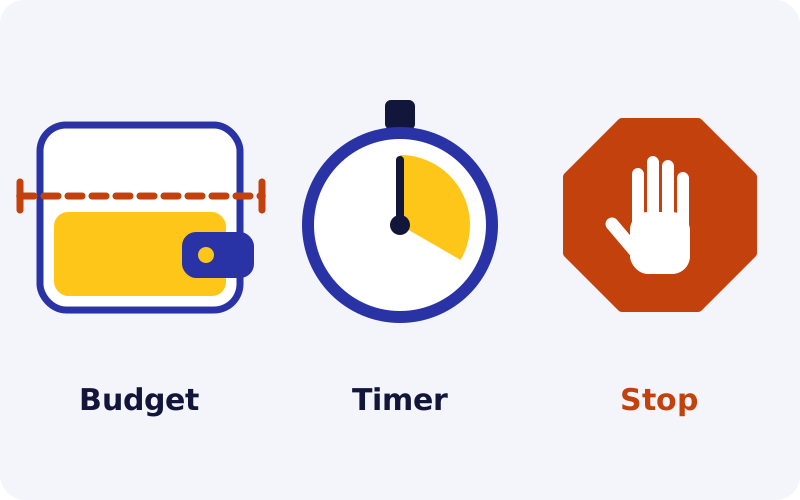
Stop for the day, and consider a longer break, if any of these apply:
- You raise your stake or target after a loss to "get back to level".
- You deposit again in the same session after the budget is spent.
- You are searching for predictors, signals or a system that "must" work.
- You are playing with borrowed money, a credit line or money set aside for bills.
- You hide how much you play or lose from family.
- You feel irritable or restless when you cannot play, or you play to escape stress.
- You cancel a pending withdrawal to keep playing.
Offshore sites normally offer deposit limits, time limits and self-exclusion, usually arranged through support. Ask Batery's live chat to set them and keep a screenshot of the confirmation. Aviator is for adults aged 18 and over only. If gambling is affecting your mood, sleep or finances, Tele-MANAS on 14416 is a free government mental-health line open round the clock, and our responsible gaming page lists practical steps. We explain where our information comes from on how we research.
Frequently asked questions
Is Battery Bet Aviator real or fake?
Aviator is a genuine game made by Spribe, and Batery holds a Curaçao gaming licence, number OGL/2024/107/0914, under the operator YouGMedia B.V. The practical risk is clone sites that copy the brand. Check the licence footer and the operator name, and confirm that your existing account works, before you deposit.
What is the RTP of Aviator?
The published return to player is 97%. Over a very large number of rounds, about ₹97 of every ₹100 staked is returned to players and about ₹3 is kept by the house. It is a long-run average, so a single session can end far above or far below it.
What is the best multiplier to cash out at?
There is no best one on value. The chance of reaching a target x is about 0.97 divided by x, which makes the expected loss 3% of the stake at every target. Lower targets such as 1.5x give smaller swings and higher targets give larger ones. Choose by how much variance you can tolerate.
Can an Aviator predictor app show the next crash point?
No. The result depends on a server seed that stays secret until the round ends and on client seeds from the first three players to bet, combined through SHA-512. No app can read or reverse those inputs. Predictor apps are scams and often carry malware that targets OTPs and UPI PINs.
Does the Martingale strategy work in Aviator?
It produces many small wins and an occasional loss large enough to cancel them. With ₹10,000, a ₹100 base stake and a 2x target, six straight losses cost ₹6,300, and that happens in about 1.87% of cycles. The average result is still a loss of 3% of the total staked.
How often does Aviator crash at 1.00x?
Under the 97% return model, roughly three rounds in a hundred end at or immediately after 1.00x, before a cash-out is possible. Those instant crashes are where the house edge comes from. They are part of the design and not evidence of the game reacting to your bet.
Can I play Aviator on Battery Bet with a bonus?
Possibly, but check first. Bonus terms often count crash games at a reduced rate or exclude them from wagering, and may cap the bet size while a bonus is active. Reviewers describe the Batery welcome offer differently, so read the terms in your own account and ask live chat to confirm.
Is there a demo version of Aviator?
Aviator normally includes a demo or fun mode with play credits, opened from the game tile. Availability before login depends on the lobby. It is useful for learning the bet panels and auto cash-out, but demo results say nothing about what a real session will do.
Is it legal to play Aviator for money in India?
The Promotion and Regulation of Online Gaming Act, 2025 prohibits offering, advertising and facilitating payments for online money games, with penalties aimed at providers rather than individual players. Disputes with an offshore operator are not heard by any Indian ombudsman. Court challenges are pending. This is general information, not legal advice.
Are Aviator winnings taxed in India?
Winnings from online games are taxable in India at 30% under section 115BBJ, with TDS provisions under section 194BA. Offshore operators generally do not deduct tax, so the liability stays with the player. Keep your own records of deposits and withdrawals and ask a tax professional about your case.
Our bottom line
Aviator is one of the more transparent casino games: the return is published, the odds reduce to a single formula and each round can be verified. That transparency cuts both ways, because it also shows that every cash-out target, staking system and signal channel ends at the same 3% average loss, paid faster than in most games. Batery, which hosts the game, holds a Curaçao gaming licence, number OGL/2024/107/0914, under the operator YouGMedia B.V. Payments from India can still be declined or reversed by banks. If you play, keep stakes small, set auto cash-out, fix a budget and stop when it is spent.
Sources
- SportsCafe: Batery review
- SportsCafe: Batery app review
- Telecom Asia: Batery casino review
- SportsBoom: Batery contact and complaints
- Wikipedia: Promotion and Regulation of Online Gaming Act, 2025
- Press Information Bureau: A New Era of Online Gaming Governance
- National Cyber Crime Reporting Portal